Third Global Food Regulators Summit (GFRS) 2025

← Back to News & Events
News & Events | Vol 1, Issue 1

Third Global Food Regulators Summit (GFRS) 2025

26th to 27th September 2025
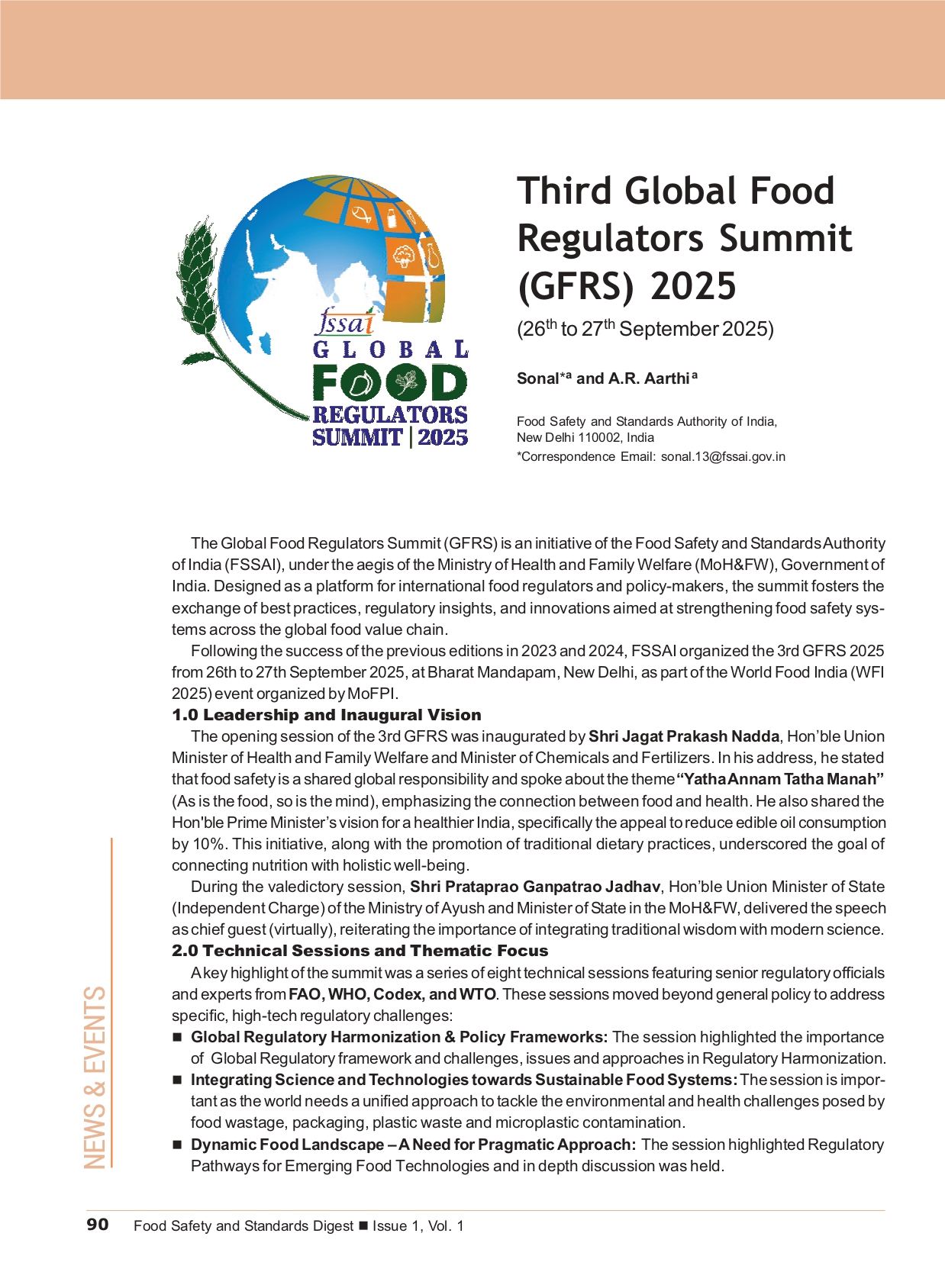
GFRS 2025 Summit

Introduction

The Global Food Regulators Summit (GFRS) is an initiative of the Food Safety and Standards Authority of India (FSSAI), under the aegis of the Ministry of Health and Family Welfare (MoH&FW), Government of India. Designed as a platform for international food regulators and policy-makers, the summit fosters the exchange of best practices, regulatory insights, and innovations aimed at strengthening food safety systems across the global food value chain.

Following the success of the previous editions in 2023 and 2024, FSSAI organized the 3rd GFRS 2025 from 26th to 27th September 2025, at Bharat Mandapam, New Delhi, as part of the World Food India (WFI 2025) event organized by MoFPI.

3rd Global Food Regulators Summit (GFRS) 2025

26–27 Sep 2025

Dates

Bharat Mandapam

New Delhi, India

World Food India 2025

Organized by MoFPI

8 Technical Sessions

FAO, WHO, Codex, WTO

Theme: "Yatha Annam Tatha Manah" — As is the food, so is the mind

1.0 Leadership and Inaugural Vision

\"GFRS \"GFRS

The opening session of the 3rd GFRS was inaugurated by Shri Jagat Prakash Nadda, Hon'ble Union Minister of Health and Family Welfare and Minister of Chemicals and Fertilizers. In his address, he stated that food safety is a shared global responsibility and spoke about the theme "Yatha Annam Tatha Manah" (As is the food, so is the mind), emphasizing the connection between food and health. He also shared the Hon'ble Prime Minister's vision for a healthier India, specifically the appeal to reduce edible oil consumption by 10%. This initiative, along with the promotion of traditional dietary practices, underscored the goal of connecting nutrition with holistic well-being.

During the valedictory session, Shri Prataprao Ganpatrao Jadhav, Hon'ble Union Minister of State (Independent Charge) of the Ministry of Ayush and Minister of State in the MoH&FW, delivered the speech as chief guest (virtually), reiterating the importance of integrating traditional wisdom with modern science.

2.0 Technical Sessions and Thematic Focus

A key highlight of the summit was a series of eight technical sessions featuring senior regulatory officials and experts from FAO, WHO, Codex, and WTO. These sessions moved beyond general policy to address specific, high-tech regulatory challenges:

1. Global Regulatory Harmonization & Policy Frameworks

The session highlighted the importance of Global Regulatory framework and challenges, issues and approaches in Regulatory Harmonization.

2. Integrating Science and Technologies towards Sustainable Food Systems

The session is important as the world needs a unified approach to tackle the environmental and health challenges posed by food wastage, packaging, plastic waste and microplastic contamination.

3. Dynamic Food Landscape – A Need for Pragmatic Approach

The session highlighted Regulatory Pathways for Emerging Food Technologies and in depth discussion was held.

4. Traditional Foods & Global Standards

Centered on India's Ayurved Aahar regulations, this theme focused on creating global benchmarks for traditional foods to ensure authenticity while meeting international safety and labeling requirements.

5. Harnessing Digital Systems for Intelligent Surveillance and Proactive Risk Management

This session explored how systems like FoSCoS and InfolNet are transitioning regulators from reactive enforcement to proactive risk management. Experts discussed using AI and Machine Learning to reduce laboratory testing turnaround time.

6. Empowering Regulators: Next-Generation Skills for a Complex Food System

This session provided insights into the emerging challenges faced by food regulators and helped to identify the best use of modern technologies for skill development with the aim of transforming and harmonizing the food regulatory landscape globally.

7. Driving Food Safety: Through Public Private Sector Engagement

This session explored strategic models that create long-term value for regulators, industry, and consumers by building trust, reducing risks and ensuring sustainability across the food value chain.

8. Combating Obesity: Nutrition, Fitness and Consumer Awareness

Addressing the "silent epidemic" of obesity through nutrition literacy and the role of front-of-pack labeling in helping consumers make informed choices.

Beyond these themes, the sessions included specific discussions on the regulation of bio-manufactured foods, with experts noting the need for mutual recognition of equivalence between countries to avoid trade duplication. Another focus was the Ayurveda Aahara Regulations, which provide a scientific framework for validating and integrating traditional Indian foods into the global safety system. Experts from the WTO shared insights on risk analysis findings from recent dispute settlement cases, providing a look at how safety standards affect international trade law.

Key Discussions & Launches at GFRS 2025

Bio-Manufactured Foods

Need for mutual recognition of equivalence between countries to avoid trade duplication

Ayurveda Aahara Regulations

Scientific framework for validating and integrating traditional Indian foods into the global safety system

WTO Risk Analysis Insights

Findings from recent dispute settlement cases on how safety standards affect international trade law

Eat Right Thali Book Launch

Traditional thalis from all 29 states showcasing balanced regional meals

FSSAI-WHO Master Class Program

CODEX and WHO Frameworks, Principles & Tools for global regulators

Digital Ecosystem – FoSCoS

Streamlined licensing for millions of FBOs, reduced lab testing times, proactive safety management

3.0 Strategic Initiatives and Digital Empowerment

Eat Right Thali Book

Eat Right Thali Book was launched during the opening session of GFRS 2025. It celebrates India's culinary heritage through traditional thalis from all 29 states, showcasing balanced regional meals that reflect local ingredients, cooking techniques, and dietary wisdom.

Digital Ecosystem Empowerment

The summit highlighted the success of India's digital platforms, such as FoSCoS (Food Safety Compliance System). These tools have streamlined licensing for millions of food business operators and reduced laboratory testing times, moving the regulatory process toward proactive safety management.

Launch of FSSAI-WHO Master Class Program in Food Safety & Risk

Under the theme CODEX and WHO Frameworks, Principles & Tools, this program was introduced to enhance technical capacity among global regulators, focusing on scientific risk assessment and international safety standards.

4.0 Bilateral Cooperation

On the sidelines of 3rd GFRS 2025, several activities were conducted:

5.0 Conclusion

The 3rd Global Food Regulators Summit reaffirmed India's commitment to a safer, more resilient, and inclusive global food ecosystem. By bringing together stakeholders from across the world, FSSAI has set a precedent for collaborative regulatory action. As the global dialogue continues, initiatives like GFRS serve as instruments for building harmonized standards and shared responsibility in ensuring the health of consumers worldwide.

Author Biography

Sonal

Food Safety and Standards Authority of India, New Delhi 110002, India

Correspondence Email: sonal.13@fssai.gov.in

A.R. Aarthi

Food Safety and Standards Authority of India, New Delhi 110002, India