Shaping Food Policies through 'Jan Bhagidari'

← Back to News & Events
News & Events | Vol 1, Issue 1

Shaping Food Policies through 'Jan Bhagidari'
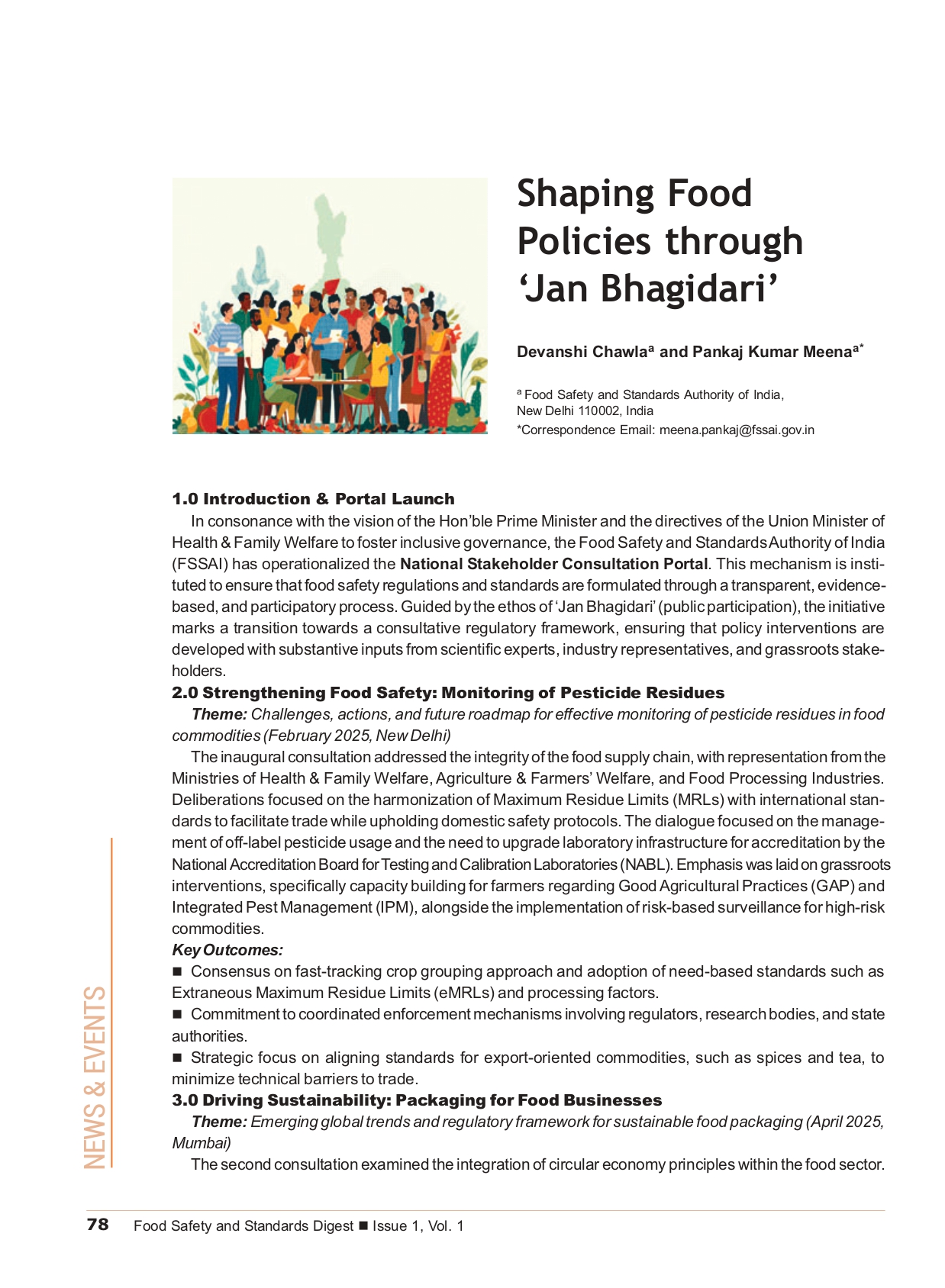
Shaping Food Policies through Jan Bhagidari

1.0 Introduction & Portal Launch

In consonance with the vision of the Hon'ble Prime Minister and the directives of the Union Minister of Health & Family Welfare to foster inclusive governance, the Food Safety and Standards Authority of India (FSSAI) has operationalized the National Stakeholder Consultation Portal. This mechanism is instituted to ensure that food safety regulations and standards are formulated through a transparent, evidence-based, and participatory process. Guided by the ethos of 'Jan Bhagidari' (public participation), the initiative marks a transition towards a consultative regulatory framework, ensuring that policy interventions are developed with substantive inputs from scientific experts, industry representatives, and grassroots stakeholders.

2.0 Strengthening Food Safety: Monitoring of Pesticide Residues

Theme: Challenges, actions, and future roadmap for effective monitoring of pesticide residues in food commodities (February 2025, New Delhi)

The inaugural consultation addressed the integrity of the food supply chain, with representation from the Ministries of Health & Family Welfare, Agriculture & Farmers' Welfare, and Food Processing Industries. Deliberations focused on the harmonization of Maximum Residue Limits (MRLs) with international standards to facilitate trade while upholding domestic safety protocols. The dialogue focused on the management of off-label pesticide usage and the need to upgrade laboratory infrastructure for accreditation by the National Accreditation Board for Testing and Calibration Laboratories (NABL). Emphasis was laid on grassroots interventions, specifically capacity building for farmers regarding Good Agricultural Practices (GAP) and Integrated Pest Management (IPM), alongside the implementation of risk-based surveillance for high-risk commodities.

Key Outcomes:

3.0 Driving Sustainability: Packaging for Food Businesses

Theme: Emerging global trends and regulatory framework for sustainable food packaging (April 2025, Mumbai)

The second consultation examined the integration of circular economy principles within the food sector. Discussions reviewed global regulatory trends and safety assessments related to chemical migration in Food Contact Materials (FCMs). A significant development was the notification permitting the use of Recycled Polyethylene Terephthalate (rPET) in food packaging, accompanied by the release of operational guidelines and the Food Contact Material – Recycled Polyethylene Terephthalate (FCM–rPET) logo. Stakeholders further deliberated on the viability of biodegradable materials, the establishment of Life Cycle Assessment (LCA) standards for bio-based packaging, and the integration of Extended Producer Responsibility (EPR) compliance with food safety regulations.

Key Outcomes:

Voices from the Consultations

"Food safety is not just a regulatory responsibility; it is fundamental to public health, economic stability and consumer trust."

"Sustainable packaging and truthful labeling are essential pillars of a resilient and future-ready food system."

Stakeholder Consultation Event Photo 1 Stakeholder Consultation Event Photo 2 Stakeholder Consultation Event Photo 3 Stakeholder Consultation Event Photo 4 Stakeholder Consultation Event Photo 5 Stakeholder Consultation Event Photo 6 Stakeholder Consultation Event Photo 7 Stakeholder Consultation Event Photo 8

Shri Prataprao Jadhav, Hon'ble Minister of State, MOH&FW — addressed the stakeholders at Vigyan Bhawan

Smt. Punya Salila Srivastava, Secretary, MoHFW — extended regards to various stakeholders

Shri G. Kamala Vardhana Rao, former CEO, FSSAI — addressed the stakeholders at Vigyan Bhawan

Dr Alka Rao, Advisor, FSSAI — addressed the gathering at the National Stakeholder Consultation on Sustainable Packaging

4.0 Empowering Consumers: Food Labelling, Advertisement and Claims

Theme: Comprehensive analysis of the regulatory framework on food labelling, advertisement, and claims (August 2025, New Delhi)

The third consultation assessed the effectiveness of existing labelling regulations related to digital commerce. The proceedings addressed concerns regarding misleading advertisements and unsubstantiated health claims, particularly on e-commerce platforms and social media. There was a consensus on the necessity of aligning domestic regulations with the Codex Alimentarius Commission (Codex) and World Health Organization (WHO) recommendations to ensure ethical communication. Participants also examined the role of multiple regulatory agencies in monitoring claims, underscoring the need for inter-agency coordination to prevent enforcement gaps.

Key Outcomes:

5.0 Bridging Science and Society: The NIFTEM-Thanjavur Initiative

Theme: Fostering meaningful engagement with diverse stakeholders

To extend the consultative process beyond the national capital, a specialized Stakeholder Consultative Meeting and Awareness Programme was convened at the National Institute of Food Technology Entrepreneurship and Management (NIFTEM), Thanjavur, on 19 and 20 December 2025. The objective was to ensure that regulations are formulated with direct empirical evidence and grassroots feedback, utilizing the platform of the International Conference on Food Science and Technology (ICFOST) 2025.

Key Features of the Dialogue:

6.0 Participation Profile: Quantum, Gender, and Format

The consultation series registered a substantial quantum of participation, engaging thousands of stakeholders cumulatively across the national and regional chapters. A deliberate emphasis on gender inclusivity was observed, particularly through the high representation of women-led Self-Help Groups (SHGs) and Anganwadi workers in the grassroots outreach. The sectoral composition remained balanced, effectively bridging the divide between high-level policymakers, technical experts from academia, and frontline supply chain functionaries. In terms of format, the consultations adopted a hybrid model – combining physical deliberations at strategic venues, such as Vigyan Bhawan and the National Institute of Food Technology, Entrepreneurship, and Management (NIFTEM), with extensive digital outreach via the portal – ensuring both the depth of discussion and the breadth of access.

7.0 Stakeholder Voices: Diverse Perspectives

The consultations successfully collated inputs from a wide spectrum of actors, ensuring that the regulatory framework reflects the ground realities of the food ecosystem. Key contributions included:

8.0 Way Forward

The 2025 National Stakeholder Consultations and the launch of the dedicated portal mark an intensified effort towards inclusive policymaking. The deliberations have identified the following strategic priorities:

These initiatives represent a continuous commitment to aligning India's food safety measures with public health mandates and stakeholder requirements.

For more updates, visit: nsc.fssai.gov.in

Author Biography

Devanshi Chawla

Food Safety and Standards Authority of India, New Delhi 110002, India

Pankaj Kumar Meena

Food Safety and Standards Authority of India, New Delhi 110002, India

Correspondence Email: meena.pankaj@fssai.gov.in