Abstract
Ayurveda Aahara has rapidly evolved from a largely implicit set of dietary practices within classical Ayurveda into a formally recognized food category that posits at the intersection of traditional knowledge, public health, innovation, and regulation. This article emphasized on ongoing policy, scientific, and market developments to outline how Ayurveda Aahara can function as a contemporary framework for preventive nutrition, responsible innovation, and global traditional foods dialogue.
1.0 Concept and Classical Foundations
The classical texts in Ayurveda accords food as a foundational role in maintaining health and preventing disease, treating Aahara as both a pillar of life and a primary prophylactic tool. The Ayurveda authoritative texts such as Charaka Samhita, Sushruta Samhita, and Ashtanga Hridaya elaborate detailed guidance on dosha-specific diets, six rasa (tastes), food combinations, seasonal adaptation, and meal timing, often blurring the boundary between food and medicine in daily practice. In this tradition, Ayurveda Aahara refers to foods prepared and consumed according to such principles, aiming to harmonise body, mind, and environment through fresh, locally appropriate, mindfully prepared diets.
2.0 Contemporary Context in India's Food Regulatory
India's integrated food safety law under the Food Safety and Standards Act, 2006 created a single, science-based framework for regulating manufacture, storage, distribution, sale, and import of all foods through the Food Safety and Standards Authority of India (FSSAI). Within this enforcement body, FSSAI has constituted expert committees, dynamic standards, and enforcement mechanisms to ensure safe and wholesome food, including for specialised categories such as certain food and food ingredients, and now Ayurveda Aahara. This unified regime in the food safety arena enables alignment of traditional food-based practices with modern risk assessment, surveillance, and consumer protection norms.
3.0 Definition and Scope of Ayurveda Aahara
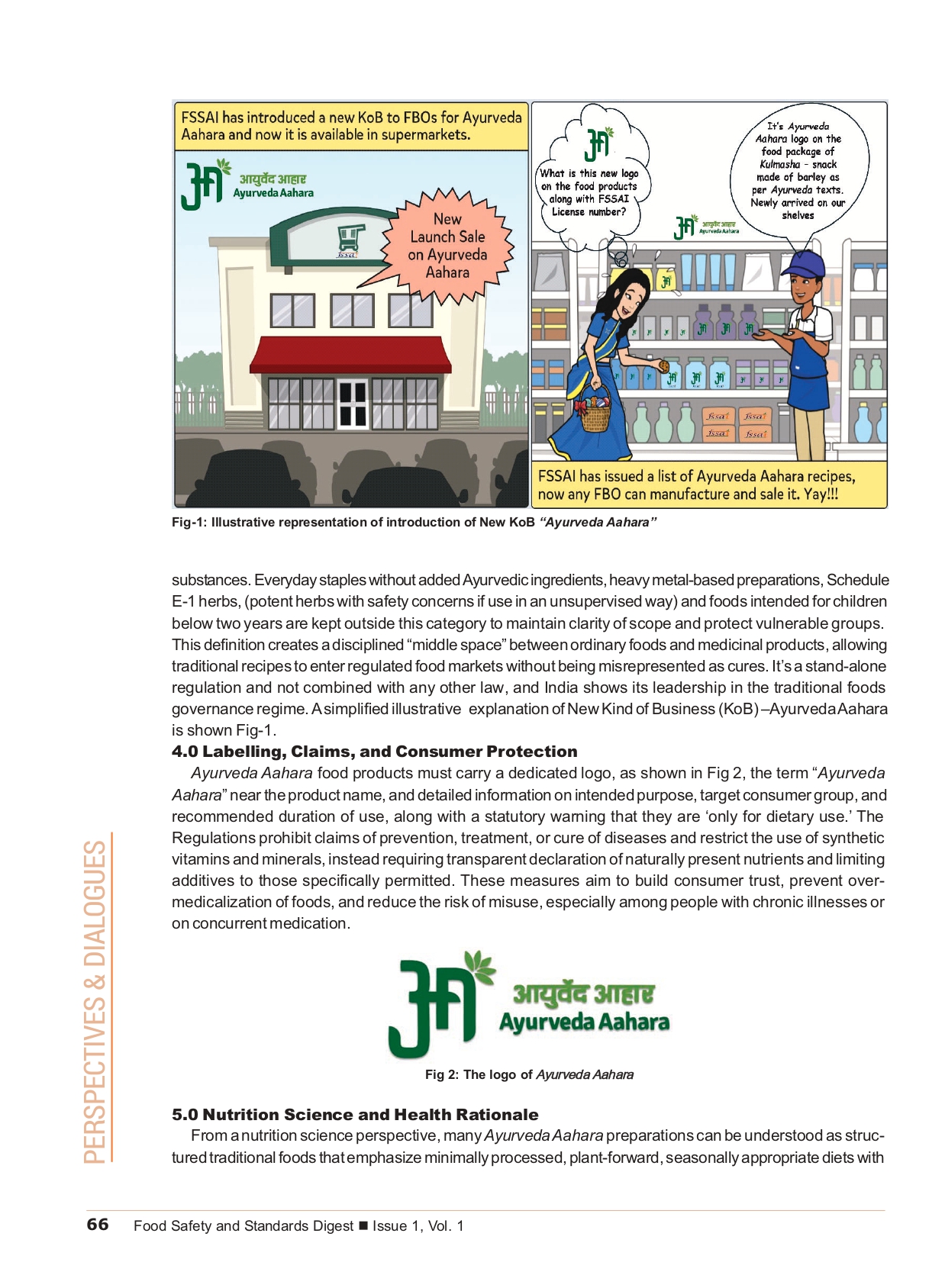
The Food Safety and Standards (Ayurveda Aahara) Regulations, 2022 define Ayurveda Aahara as food prepared in accordance with recipes, ingredients, or processes described in authoritative Ayurveda texts, while explicitly excluding Ayurvedic drugs, proprietary medicines, cosmetics, narcotic or psychotropic substances. Everyday staples without added Ayurvedic ingredients, heavy metal-based preparations, Schedule E-1 herbs (potent herbs with safety concerns if use in an unsupervised way), and foods intended for children below two years are kept outside this category to maintain clarity of scope and protect vulnerable groups. This definition creates a disciplined "middle space" between ordinary foods and medicinal products, allowing traditional recipes to enter regulated food markets without being misrepresented as cures. It's a stand-alone regulation and not combined with any other law, and India shows its leadership in the traditional foods governance regime. A simplified illustrative explanation of New Kind of Business (KoB) – Ayurveda Aahara is shown in Fig-1.
Fig-1: Illustrative Representation of Introduction of New KoB "Ayurveda Aahara"
Dairy, Bakery, Meat & Poultry, Snacks, Beverages, etc.
Foods based on authoritative Ayurveda texts
Distinct licensing category for Ayurveda Aahara products
Exclusions: Ayurvedic drugs, proprietary medicines, cosmetics, narcotic/psychotropic substances, everyday staples without Ayurvedic ingredients, heavy metal-based preparations, Schedule E-1 herbs, foods for children below 2 years
4.0 Labelling, Claims, and Consumer Protection
Ayurveda Aahara food products must carry a dedicated logo, as shown in Fig 2, the term "Ayurveda Aahara" near the product name, and detailed information on intended purpose, target consumer group, and recommended duration of use, along with a statutory warning that they are 'only for dietary use.' The Regulations prohibit claims of prevention, treatment, or cure of diseases and restrict the use of synthetic vitamins and minerals, instead requiring transparent declaration of naturally present nutrients and limiting additives to those specifically permitted. These measures aim to build consumer trust, prevent over-medicalization of foods, and reduce the risk of misuse, especially among people with chronic illnesses or on concurrent medication.
Fig 2: The Logo of Ayurveda Aahara
आयुर्वेद
आहार
AYURVEDA AAHARA
Dedicated logo to be displayed on all Ayurveda Aahara food product packaging
5.0 Nutrition Science and Health Rationale
From a nutrition science perspective, many Ayurveda Aahara preparations can be understood as structured traditional foods that emphasize minimally processed, plant-forward, seasonally appropriate diets with attention to digestion, gut health, and long-term metabolic balance. Contemporary research on traditional Ayurvedic foods has highlighted benefits of fermented preparations, and herbs-enriched food preparations for micronutrient bioavailability, immune modulation, and chronic disease risk reduction, echoing classical emphasis on sattvic qualities and appropriate combinations. Thus, Ayurveda Aahara offers a platform for designing culturally rooted functional foods that remain firmly regulated as "food" rather than drifting into unregulated markets.
6.0 Innovation, Opportunities and Economic Potential
Innovation in Ayurveda Aahara spans product development, processing technologies, and business models, with particular scope in functional foods, ready-to-eat and ready-to-drink formats, and personalized nutrition offerings aligned with dosha and life-stage needs. Rising consumer demand for herbal, "back to roots," and immunity-supporting products, especially after the COVID-19 pandemic, has expanded market space for Ayurveda-based juices, confectionery, snacks, and meal components within mainstream fast-moving consumer goods. The broader Ayush sector's rapid growth and the emergence of tens of thousands of micro, small, and medium enterprises suggest that Ayurveda Aahara could contribute significantly to livelihood generation, rural value chains, and export-led branding of "Make in India" traditional foods. Leadership with these regulations provide great opportunity to build global brands including with an Ayurveda Aahara LOGO that law permits to use on all packs and in media and advertisements.
7.0 Consumer Preferences and Social Significance
Contemporary consumers increasingly seek foods that align with health, sustainability, authenticity, and personal identity, making Ayurveda Aahara particularly resonant due to its emphasis on naturalness, local ingredients, and personalised suitability. Innovation in traditional foods through improved convenience, packaging, safety, and shelf life can help maintain relevance while preserving sensory and cultural identity, provided that changes do not erode the core characteristics valued by communities. At a social level, Ayurveda Aahara encourages longer-term, habit-based dietary shifts rather than quick-fix cures, reinforcing ideas of mindful eating, balance, and shared responsibility for health within households and communities.
8.0 Technological Integration and Food Engineering
Modern food engineering offers tools to scale Ayurveda Aahara without compromising safety, using technologies such as controlled refrigeration, advanced packaging, pasteurization, biosensors, and digital traceability systems to maintain quality and authenticity along the supply chain. Emerging technologies – including three-dimensional food printing, smart sensors, eco-friendly packaging, and AI-enabled quality monitoring – can be adapted to develop customized Ayurveda Aahara products while supporting sustainability and resource efficiency. Such integration requires careful validation to ensure processing methods in respect to Ayurvedic principles on heating, fermentation, and ingredient compatibility, which can significantly affect the properties and acceptability of foods. There is immense scope to adopt innovative packaging practices from other sectors for Ayurveda Aahara manufacturing, subject to due diligence and validation.
9.0 Regulatory Framework and Governance Dynamics
FSSAI, as the food regulator, has embedded Ayurveda Aahara within the broader ecosystem of science-based standards, risk assessments, and stakeholder consultation processes, including expert committees convened with the Ministry of Ayush to evaluate traditional food products and their claims. The creation of a distinct licensing category of Ayurveda Aahara on the FoSCoS portal, a compendium of recognized traditional food products, and specific microbiological and hygiene norms further institutionalizes the category and offers predictability to businesses. The Ayurveda Aahara food products are only those that are made in pre-packaged conditions available for consumers use as per instructions for use. Being classified as food products, Ayurveda Aahara offers a distinct global advantage across multiple dimensions.
10.0 Globalisation and Research Agenda
The policy discourse increasingly positions Ayurveda Aahara as a potential contributor to global nutrition debates on sustainable, culturally grounded, health-promoting diets. Realizing this ambition, it demands robust interdisciplinary research, including clinical studies, mechanistic nutrition research, consumer behavior analysis, and social science work on equity and access, so that traditional claims are translated into contemporary evidence without eroding cultural integrity. International standard-setting, including possible engagement with Codex-style processes, could offer a platform for articulating Ayurveda Aahara principles in dialogue with other traditional and modern dietary systems worldwide.
11.0 Future Prospects and Policy Directions
Looking ahead, Ayurveda Aahara regulation policy and practice can evolve along several axes: strengthening protection of traditional knowledge, integrating Ayurveda Aahara into curricula for food, nutrition, and public health professionals, and fostering dedicated scientific panels and networks focused on this category. At the same time, support structures for small enterprises, including capacity-building on compliance, quality management, and documentation, will play a crucial role to ensure that formalization does not exclude informal, community-based actors. Ultimately, the promise of Ayurveda Aahara lies in enabling a shared "future plate" where individualized dietetics, ecological responsibility, cultural continuity, and regulatory accountability reinforce each other in everyday eating rather than remaining confined to niche wellness markets.
Further Readings
Food Safety and Standards Authority of India. (2022, May 5). Food Safety and Standards (Ayurveda Aahara) Regulations, 2022 (Gazette Notification). Government of India. https://fssai.gov.in/upload/notifications/2022/05/62789a20b54bdGazette_Notification_Ayurveda_Aahara_09_05_2022.pdf
Food Safety and Standards Authority of India. (2025, July 25). Ayurveda Aahara covered under Food Safety and Standards (Ayurveda Aahara) Regulations, 2022 (Order). Government of India. https://fssai.gov.in/upload/uploadfiles/files/Order%20dated%2025-07-2025%20enclosing%20Ayurveda%20Aahara.pdf
Kaushik, R., Upadhyaya, K., & Sharma, P. (2025). A comprehensive review of Ayurveda Aahar: Regulations, challenges, and future prospects. Journal of Drug Research in Ayurvedic Sciences, 10(3), 181–188. https://doi.org/10.4103/jdras.jdras_404_24
Rao, G. K. V. (2024). Ayurveda Aahar and its future prospects. Journal of Drug Research in Ayurvedic Sciences, 9(Suppl 1), S6–S7. https://doi.org/10.4103/jdras.jdras_405_24
Srivastava, A., Swami, K., Srivastava, K., Kotecha, M., & Sharma, S. (2024). Unveiling Ayurveda Aahara and regulatory provisions. Journal of Drug Research in Ayurvedic Sciences, 9(Suppl 1), S42–S47. https://doi.org/10.4103/jdras.jdras_245_24