1.0 Introduction
Mother Nature has designed milk as a nutrient dense food source that nourishes and provides immunological protection to the mammalian off-spring. Because of their unique nutrient profile, most dairy foods are designated as protective foods, i.e. foods in which the concentration of essential nutrients is high in relation to the foods energy value. Production and marketing of dairy foods is highly commercialized due to their importance (nutrition and health benefits) and popularity (wide variety, vast choice, easy availability and affordability and sensory supremacy). The Food Safety and Standard Act (2006) assures the quality and safety of milk and milk products by regulating their manufacture, storage, distribution, sale and import to ensure availability of safe and wholesome food for human consumption.
2.0 What Are Dairy Analogues?
Dairy analogues are food products that resemble traditional milk and milk products but are made using non-milk ingredients, such as plant-based proteins and fats, to replace dairy components partially or completely. Common examples include cheeses (imitation cheeses, cheese-like products, processed cheese analogues, processed cheese foods, processed cheese spreads), paneer (paneer analogues), yoghurts, and ice-cream (frozen dessert). They are designed to mimic the sensory characteristics i.e., appearance, flavour and texture, and functional properties of their dairy counterparts.
The dairy analogues originated primarily due to the following reasons:
- To replace dairy foods for individuals with lactose intolerance and milk allergies.
- To cater to the needs of the population demanding plant-based diet partially or wholly or those following a strict plant-based diet (Vegans).
- To innovate and diversify the production of dairy alternatives and substitutes using a different source of ingredients, mainly plant based options, and production methods.
- To reduce the cost of production through the substitution of selected milk components by cheaper vegetable products (some analogues, like analogue paneer, can be more cost-effective than traditional dairy versions).
- To produce products with improved techno-functional and functional properties.
3.0 Food Safety and Standard Regulations on Dairy Analogues
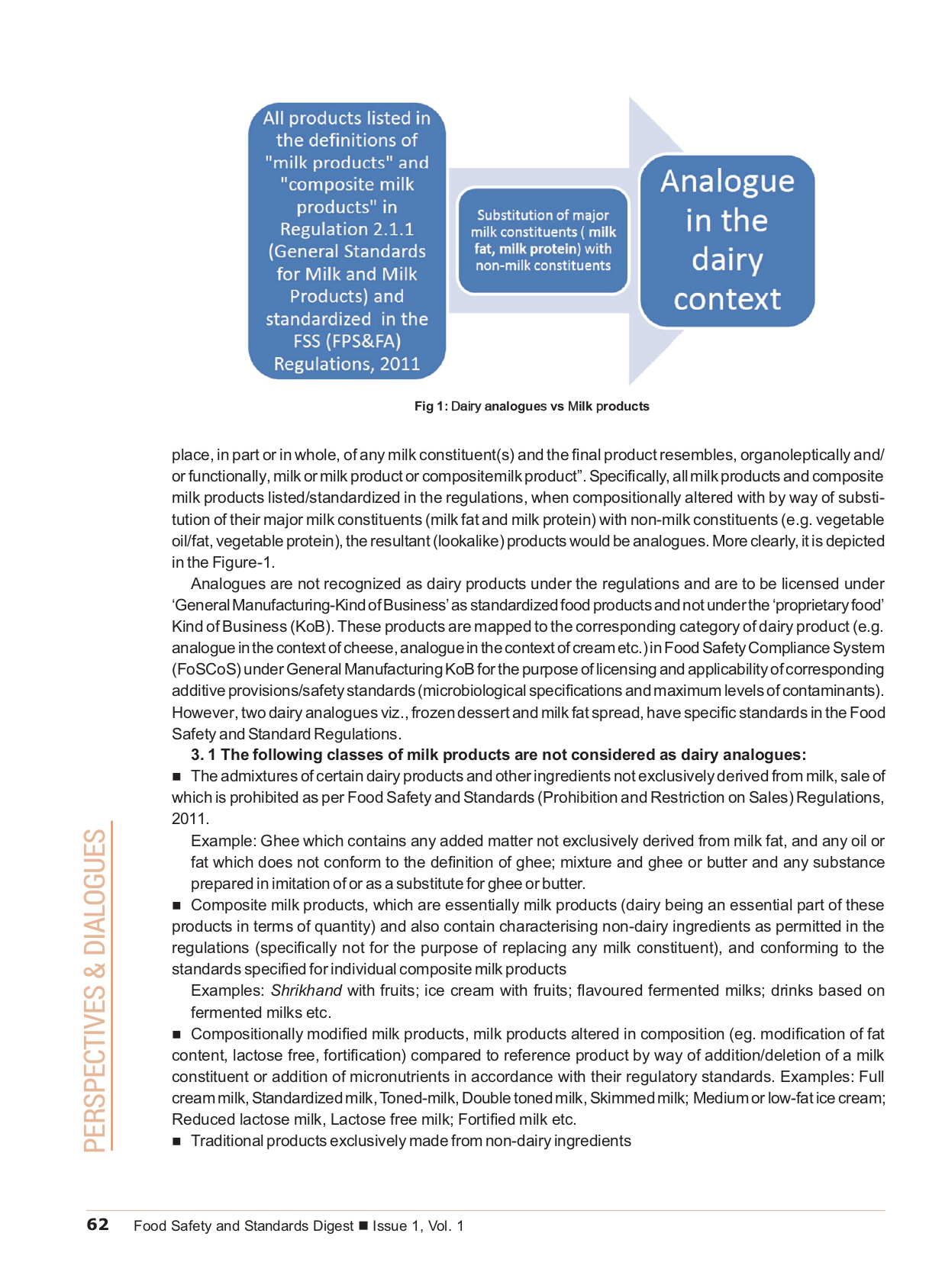
As per Food Safety and Standards (Food Product Standards and Additives) Regulations 2011, Dairy Analogues in the dairy context are defined as "products in which constituents not derived from milk take the place, in part or in whole, of any milk constituent(s) and the final product resembles, organoleptically and/or functionally, milk or milk product or composite milk product". Specifically, all milk products and composite milk products listed/standardized in the regulations, when compositionally altered by way of substitution of their major milk constituents (milk fat and milk protein) with non-milk constituents (e.g. vegetable oil/fat, vegetable protein), the resultant (lookalike) products would be analogues. More clearly, it is depicted in Fig 1.
Analogues are not recognized as dairy products under the regulations and are to be licensed under 'General Manufacturing – Kind of Business' as standardized food products and not under the 'proprietary food' Kind of Business (KoB). These products are mapped to the corresponding category of dairy product (e.g. analogue in the context of cheese, analogue in the context of cream etc.) in Food Safety Compliance System (FoSCoS) under General Manufacturing KoB for the purpose of licensing and applicability of corresponding additive provisions/safety standards (microbiological specifications and maximum levels of contaminants). However, two dairy analogues viz., frozen dessert and milk fat spread, have specific standards in the Food Safety and Standard Regulations.
Fig 1: Dairy Analogues vs Milk Products
Milk Products
- Made exclusively from milk constituents (milk fat & milk protein)
- Regulated under dairy product standards
- Licensed under Dairy KoB in FoSCoS
- Examples: Cheese, Paneer, Ice Cream, Yoghurt, Cream, Ghee
Dairy Analogues
- Milk constituents partially or wholly replaced by non-milk ingredients (vegetable oil/fat, vegetable protein)
- Not recognized as dairy products
- Licensed under General Manufacturing KoB in FoSCoS
- Examples: Cheese analogue, Paneer analogue, Frozen dessert, Milk fat spread
3.1 The Following Classes of Milk Products Are Not Considered as Dairy Analogues
-
Admixtures of certain dairy products and other ingredients not exclusively derived from milk, sale of which is prohibited as per Food Safety and Standards (Prohibition and Restriction on Sales) Regulations, 2011.
Example: Ghee which contains any added matter not exclusively derived from milk fat, and any oil or fat which does not conform to the definition of ghee; mixture and ghee or butter and any substance prepared in imitation of or as a substitute for ghee or butter. -
Composite milk products, which are essentially milk products (dairy being an essential part of these products in terms of quantity) and also contain characterising non-dairy ingredients as permitted in the regulations (specifically not for the purpose of replacing any milk constituent), and conforming to the standards specified for individual composite milk products.
Examples: Shrikhand with fruits; ice cream with fruits; flavoured fermented milks; drinks based on fermented milks etc. -
Compositionally modified milk products, milk products altered in composition (e.g. modification of fat content, lactose free, fortification) compared to reference product by way of addition/deletion of a milk constituent or addition of micronutrients in accordance with their regulatory standards.
Examples: Full cream milk, Standardized milk, Toned-milk, Double toned milk, Skimmed milk; Medium or low-fat ice cream; Reduced lactose milk, Lactose free milk; Fortified milk etc. -
Traditional products exclusively made from non-dairy ingredients.
Examples: Coconut milk, Peanut butter, other plant-based (such as soy, nuts, rice) beverages etc. -
Products of other food categories (e.g. Cocoa products, Bakery products) containing dairy ingredients only as an essential part for characterization of the product.
Examples: Milk chocolate, Milk biscuits, Cream biscuits, Cheese cake, Butter cookies etc.
3.2 Specific Labelling Provisions for Dairy Analogues
-
If milk constituent(s) (milk fat and/or milk protein) is partly replaced by a constituent not derived from milk (e.g., vegetable oil/fat and/or vegetable protein) in the product, the manner of declaration will be:
"Contains ……………….." (Blank to be filled with the name of the constituent and source.)
Examples: If Soy protein concentrate is used as a protein constituent, partly replacing milk protein in the product, the declaration will be "Contains Soy Protein". If hydrogenated vegetable fat from mixed oil source is used as a fat constituent partly replacing milk fat in the product, the declaration will be "Contains Mixed Vegetable Fat". -
If milk constituent(s) (milk fat and/or milk protein) is fully replaced/substituted by a constituent not derived from milk (e.g., vegetable oil/fat and/or vegetable protein) in the product, the manner of additional declaration will be:
"Contains no ……………….." (Blank to be filled with name of the constituent, i.e., Milk Fat and or Milk Protein) -
Dairy analogues for which no identity standards have been specified in the regulations shall declare on their labels the word 'Analogue' along with food category number under which the product is licensed.
Examples: For cheese, the label declaration shall be: "Analogue-1.6.5" and for cream analogue, it shall be "Analogue-1.4.4" - Analogues, in the dairy context, cannot use the nomenclature of milk and milk products.
- Further, as per the Draft Notification F. No. SS-T017/1/2023-Standard-FSSAI, 17th February, 2025 of FSSAI, all milk and milk products, including composite milk products, as per Food Safety and Standards (Food Products Standards and Food Additives) Regulations, 2011, shall carry the logo as specified in Fig 2 on the label of the products; dairy analogues shall not use the logo.
Fig 2: Milk Logo
PRODUCT
As per Draft Notification F. No. SS-T017/1/2023-Standard-FSSAI (17th Feb, 2025)
Dairy analogues shall not use this logo.
Even the international regulations for dairy analogues focus on correct labelling and preventing consumer deception, with specific rules varying from region to region. Key requirements often include use of "non-dairy" or "analogue" in the product name, clearly listing substitute ingredients like plant-based oils, and ensuring food service establishments disclose the presence of these products on menus.
Generic dairy terms are often restricted to their traditional meaning, preventing "analogue" products from being marketed as milk or milk products.
Analogue Paneer
Analogue paneer, which has been in news in the recent months, is made by blending vegetable oils (palm oil), vegetable fats (palm stearin), starches, milk solids (SMP) and plant proteins (soy, pea) along with stabilizers, emulsifiers and artificial flavours, and curdling the blend using the common acidulants. This process creates a cheaper substitute that mimics the look and texture of paneer but has a different nutritional profile. The popularity of paneer analogues is mainly due to cost cutting, increased demand for plant-based alternatives, and claims for better nutritional, functional and sensory characteristics.
4.0 Conclusion
Being cheaper alternatives to dairy products, dairy analogues are often used to mimic the popular dairy products, especially Paneer and Cheese. This is a serious issue since such analogues are (mis)-used as the corresponding dairy products especially in the Hotel, Restaurants and Cafes/Catering (HoReCa) Sector. While provisions do exist in the Regulations, as detailed above, there is a need to introduce suitable parameters to differentiate the dairy products and their analogues. Distinct nomenclature, labelling and standards, along with simultaneous development of methods for these standards, can help distinguish dairy products from the dairy analogues. Restricting the marketing of dairy analogues, especially paneer and cheese analogues, only in the pre-packaged form of small quantities (say up to maximum 500 g per package) may also help avoid their misuse in HoReCa sector.