1.0 Introduction
Pesticides play a vital role for effective management of pests and have been instrumental in augmenting agricultural productivity by preventing extensive crop destruction, enhancing output, and consequently boosting farm income. However, their injudicious use and inherent toxicity continues to remain a pivotal challenge to the public health paradigm. Consumers have to be assured that they are not exposed to unacceptable levels of pesticide residues. Maximum Residue Limits (MRLs) are the legal standard for pesticide residues worldwide which are established by the regulatory bodies of the respective countries based on their Good Agricultural Practices (GAP) taking into account the toxicity of the pesticides.
2.0 Regulatory Framework for Pesticides In India
In India, for ensuring food, human health and environment safety, pesticide use has been put under strict regulations. Pesticide manufacture, import, export, transport, sale, distribution and use in India is regulated under the Insecticides Act 1968, and Rules 1971. Central Insecticide Board and Registration Committee (CIB&RC) facilitates registration, and the Food Safety and Standards Authority of India (FSSAI) lays down science based standards for food products. The issues related to food safety vis-a-vis pesticide residues, and Maximum Residue Limits (MRLs) etc. are dealt under the Food Safety and Standards Act, 2006 and Food Safety and Standards (contaminants, toxins and residues) Regulation, 2011. At the international level, Codex Maximum Residue Limits (CXLs) for pesticide residues in food items or in groups of food or feed that move in international trade are set by the Joint FAO/WHO Meeting on Pesticides Residues (JMPR), an expert ad hoc body administered jointly by FAO and WHO which is responsible for the scientific assessment of the pesticide toxicological and residue data.
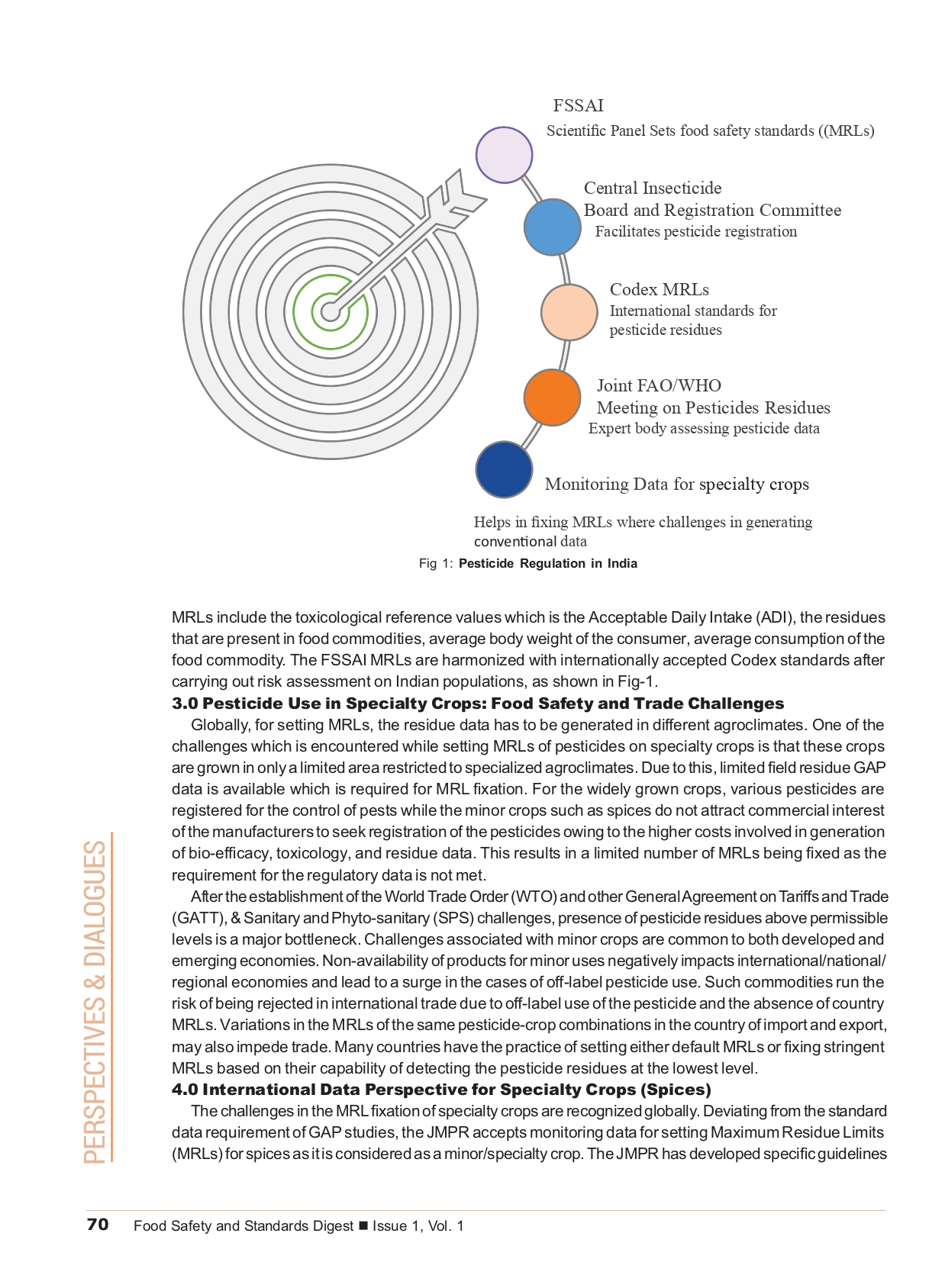
Internationally, Joint Food and Agriculture Organization (FAO)/ World Health Organization (WHO)/ Codex Alimentarius Commission (CAC) member countries establish science-based food standards to ensure food safety, quality and fairness of international trade. India is signatory to CAC and one of the few countries in the world which has a robust system for fixing MRLs and of course the procedures for the risk assessment and fixation of MRL for the pesticide residues and other contaminants which is followed by FSSAI is in line with the international procedures followed by FAO/WHO/JMPR. The parameters that are considered to set MRLs include the toxicological reference values which is the Acceptable Daily Intake (ADI), the residues that are present in food commodities, average body weight of the consumer, average consumption of the food commodity. The FSSAI MRLs are harmonized with internationally accepted Codex standards after carrying out risk assessment on Indian populations, as shown in Fig-1.
Fig 1: Pesticide Regulation in India
Expert body assessing pesticide data
International standards for pesticide residues
Facilitates pesticide registration
Sets food safety standards (MRLs)
Helps in fixing MRLs where challenges in generating conventional data
3.0 Pesticide Use in Specialty Crops: Food Safety and Trade Challenges
Globally, for setting MRLs, the residue data has to be generated in different agroclimates. One of the challenges which is encountered while setting MRLs of pesticides on specialty crops is that these crops are grown in only a limited area restricted to specialized agroclimates. Due to this, limited field residue GAP data is available which is required for MRL fixation. For the widely grown crops, various pesticides are registered for the control of pests while the minor crops such as spices do not attract commercial interest of the manufacturers to seek registration of the pesticides owing to the higher costs involved in generation of bio-efficacy, toxicology, and residue data. This results in a limited number of MRLs being fixed as the requirement for the regulatory data is not met.
After the establishment of the World Trade Order (WTO) and other General Agreement on Tariffs and Trade (GATT), & Sanitary and Phyto-sanitary (SPS) challenges, presence of pesticide residues above permissible levels is a major bottleneck. Challenges associated with minor crops are common to both developed and emerging economies. Non-availability of products for minor uses negatively impacts international/national/regional economies and lead to a surge in the cases of off-label pesticide use. Such commodities run the risk of being rejected in international trade due to off-label use of the pesticide and the absence of country MRLs. Variations in the MRLs of the same pesticide-crop combinations in the country of import and export, may also impede trade. Many countries have the practice of setting either default MRLs or fixing stringent MRLs based on their capability of detecting the pesticide residues at the lowest level.
4.0 International Data Perspective for Specialty Crops (Spices)
The challenges in the MRL fixation of specialty crops are recognized globally. Deviating from the standard data requirement of GAP studies, the JMPR accepts monitoring data for setting Maximum Residue Limits (MRLs) for spices as it is considered as a minor/specialty crop. The JMPR has developed specific guidelines for the submission and evaluation of monitoring data for recommending MRLs for spices to ensure a consistent and scientifically sound approach. Traditionally, MRLs are established based on data from supervised field trials, which involve applying pesticides according to Good Agricultural Practices (GAP) and measuring the resulting residues. However, conducting such studies for spices is often economically unfeasible for pesticide manufacturers. Monitoring data, collected from national surveillance programs and industry bodies, provides valuable real-world information on the actual residue levels in commodities as they are available in the market and move in international trade. This offers a practical way to assess typical exposure levels when formal trial data is missing. The JMPR uses this data for assessing potential consumer dietary risk, helping to ensure that the established MRLs are protective of public health.
5.0 Case Study: Pesticide Residue Monitoring Data for Risk Assessment and MRL Fixation
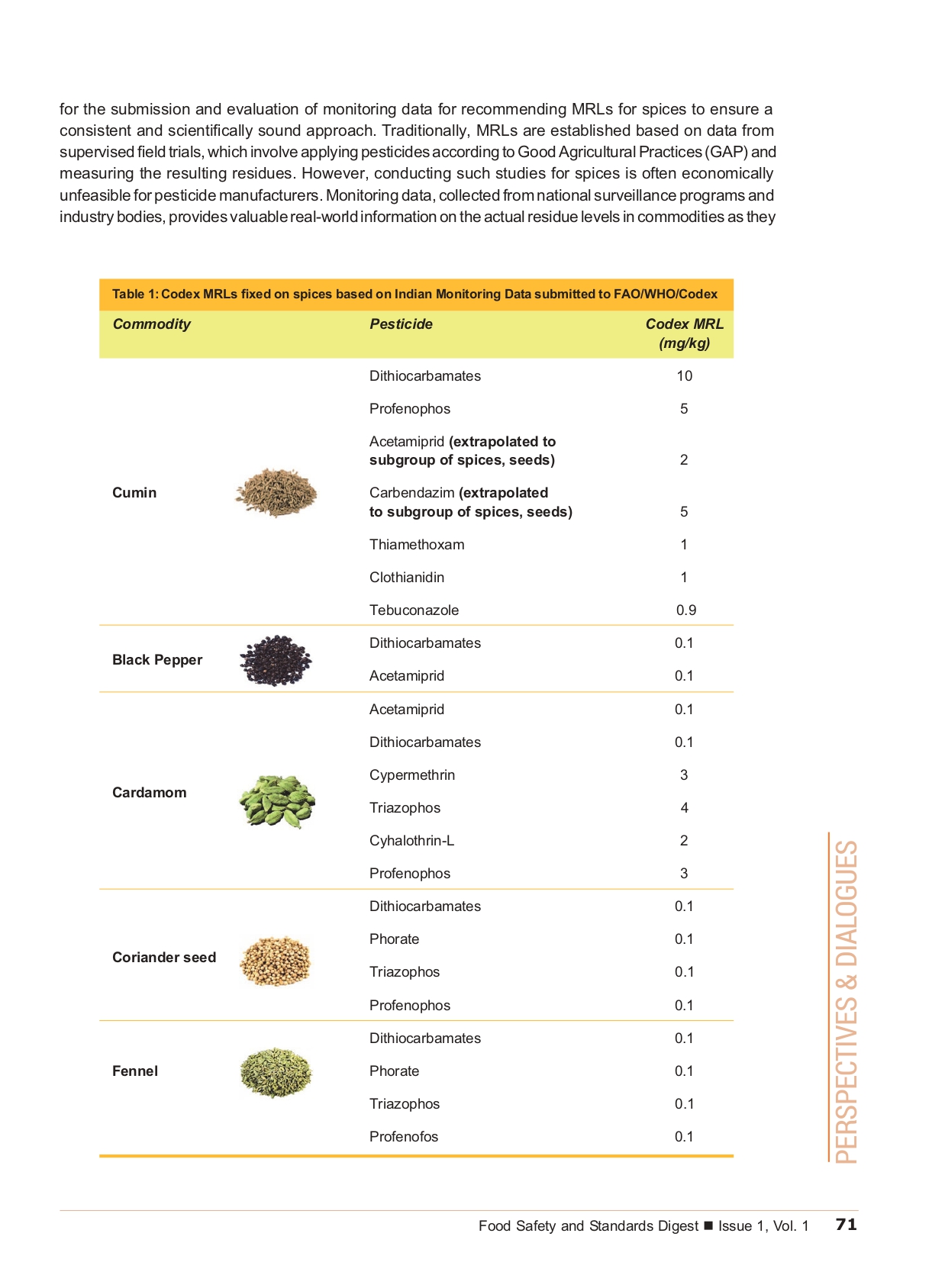
India is the largest producer, consumer and exporter of spices to the world. Spice commodities run the risk of being rejected in international trade on account of absence of MRLs. Variations in the MRLs of the same pesticide-crop combinations in the country of import and export, may also impede trade. To overcome these challenges, the ICAR-All India Network Project on Pesticide Residues & Contaminants (AINP-PR&C) is generating monitoring data on spices under the Department of Agriculture and Farmers Welfare, Ministry of Agriculture and Farmers Welfare, sponsored central sector project on "Monitoring of Pesticide Residue at National Level (MPRNL). Through the India National Codex Contact Point (NCCP), FSSAI, the data is being regularly submitted to FAO/WHO/JMPR for risk assessment by JMPR and fixation of Codex MRLs (CXLs). During 2014 to 2025, Codex MRLs (CXLs) for 23 pesticide-spice combinations on five different spices (cardamom, coriander, fennel, cumin, pepper (black and white)) have been fixed based on the data submitted by India (Table 1). This reflects India's scientific contribution to Codex and helps align global standards with Indian production realities, reducing the risk of export rejections in spice consignments.
Table 1: Codex MRLs Fixed on Spices Based on Indian Monitoring Data Submitted to FAO/WHO/Codex
| Commodity | Pesticide | Codex MRL (mg/kg) |
|---|---|---|
| Cumin | Dithiocarbamates | 10 |
| Profenophos | 5 | |
| Acetamiprid (extrapolated to subgroup of spices, seeds) | 2 | |
| Carbendazim (extrapolated to subgroup of spices, seeds) | 5 | |
| Thiamethoxam | 1 | |
| Clothianidin | 1 | |
| Tebuconazole | 0.9 | |
| Black Pepper | Dithiocarbamates | 0.1 |
| Acetamiprid | 0.1 | |
| Cardamom | Acetamiprid | 0.1 |
| Dithiocarbamates | 0.1 | |
| Cypermethrin | 3 | |
| Triazophos | 4 | |
| Cyhalothrin-L | 2 | |
| Profenophos | 3 | |
| Coriander Seed | Dithiocarbamates | 0.1 |
| Phorate | 0.1 | |
| Triazophos | 0.1 | |
| Profenophos | 0.1 | |
| Dithiocarbamates | 0.1 | |
| Fennel | Phorate | 0.1 |
| Triazophos | 0.1 | |
| Profenofos | 0.1 |
6.0 Conclusion
Considering the challenges associated with conventional data generation for MRL fixation in specialty crops, the acceptance of monitoring data by JMPR provides a practically and scientifically sound alternative for establishment of Codex MRLs (CXLs). This approach plays a critical role in resolving trade disputes and ensuring a smooth flow of spices in global commerce under the WTO's SPS agreement. India's proactive engagement in generating and submitting high quality monitoring data has contributed substantially to the development of Codex standards, strengthening food safety, enhancing international trade.