Implementing ISO 22000 and FSSC 22000 in Dairy Plants

← Back to Research & Innovation
Research Article | Vol 1, Issue 1

Implementing ISO 22000 and FSSC 22000 in Dairy Plants to Mitigate Cross-Contamination of Antimicrobial Resistance
ISO 22000 and FSSC 22000 in Dairy Plants

Abstract

Antimicrobial resistance (AMR) is a global One-Health issue that impacts food production systems, particularly in the dairy sector, and transcends clinical environments. The management of raw milk, communal equipment, biofilms, human vectors, and environmental reservoirs presents distinct cross-contamination challenges in dairy processing operations. The Global Food Safety Initiative's (GFSI) sanctioned FSSC 22000 scheme and ISO 22000:2018 exemplify Food Safety Management Systems (FSMS) that provide organized frameworks facilitating hazard analysis (HA), validation/verification, prerequisite programs (PRPs), and ongoing enhancement. Provided that AMR-specific surveillance, biofilm-validated sanitation, supplier regulation, and sanitizer management are integrated into the FSMS, this technical opinion asserts that proactive certification under ISO 22000 and FSSC 22000 markedly enhances dairy facilities' capacity to avoid, identify, and control cross-contamination by antimicrobial-resistant bacteria.

Keywords: Antimicrobial Resistance; ISO 22000; FSSC 22000; Dairy; Cross-Contamination; Food Safety Management

1.0 Introduction

Given that human, animal, and environmental reservoirs continuously interact and might facilitate the dissemination of resistant bacteria and resistance genes, antimicrobial resistance (AMR) increasingly demands a One-Health approach. Resistance in dairy systems can originate on farms through the administration of antibiotics for therapeutic or prophylactic reasons (such as mastitis treatment), persist in raw milk, continue in processing environments, and subsequently disseminate to handlers or final products (WHO, 2016). Consequently, contaminated raw milk, biofilms on equipment surfaces, inadequate cleaning and sanitization, cross-contamination between personnel and equipment, and environmental niches such as drains and condensate provide the dairy processing environment both a potential reservoir and a catalyst for antimicrobial-resistant organisms. Due to the systemic nature of these mechanisms, the mitigation of AMR at the plant level necessitates the implementation of formalized, audited management systems that integrate validated prerequisite programs (PRP), risk-based hazard analysis, and regular verification, alongside ad hoc interventions (Ban-Cucerzan et al., 2025).

According to ISO 22000:2018, a food safety management system must traditionally include HACCP principles, prerequisite programs (PRPs), and components of management systems such as leadership, planning, support, operation, performance evaluation, and improvement. The standard emphasizes risk-based management and is comprehensive, allowing for application throughout the food chain. FSSC 22000 is a scheme that enhances ISO 22000 by including scheme-level additional requirements and guidelines, together with sector-specific PRP requirements such as ISO/TS 22002-1. The importance of FSSC 22000 Version 6 for export and retail supply chains requiring GFSI-recognized certification heightened with the inclusion of normative-PRP criteria and the attainment of GFSI recognition. Certification is crucial as it fosters documented implementation beyond mere design, regular third-party verification, supplier mandates, and continuous improvement practices that directly enhance the controls necessary to mitigate AMR bacterial cross-contamination risks (IAF & ISO, 2020).

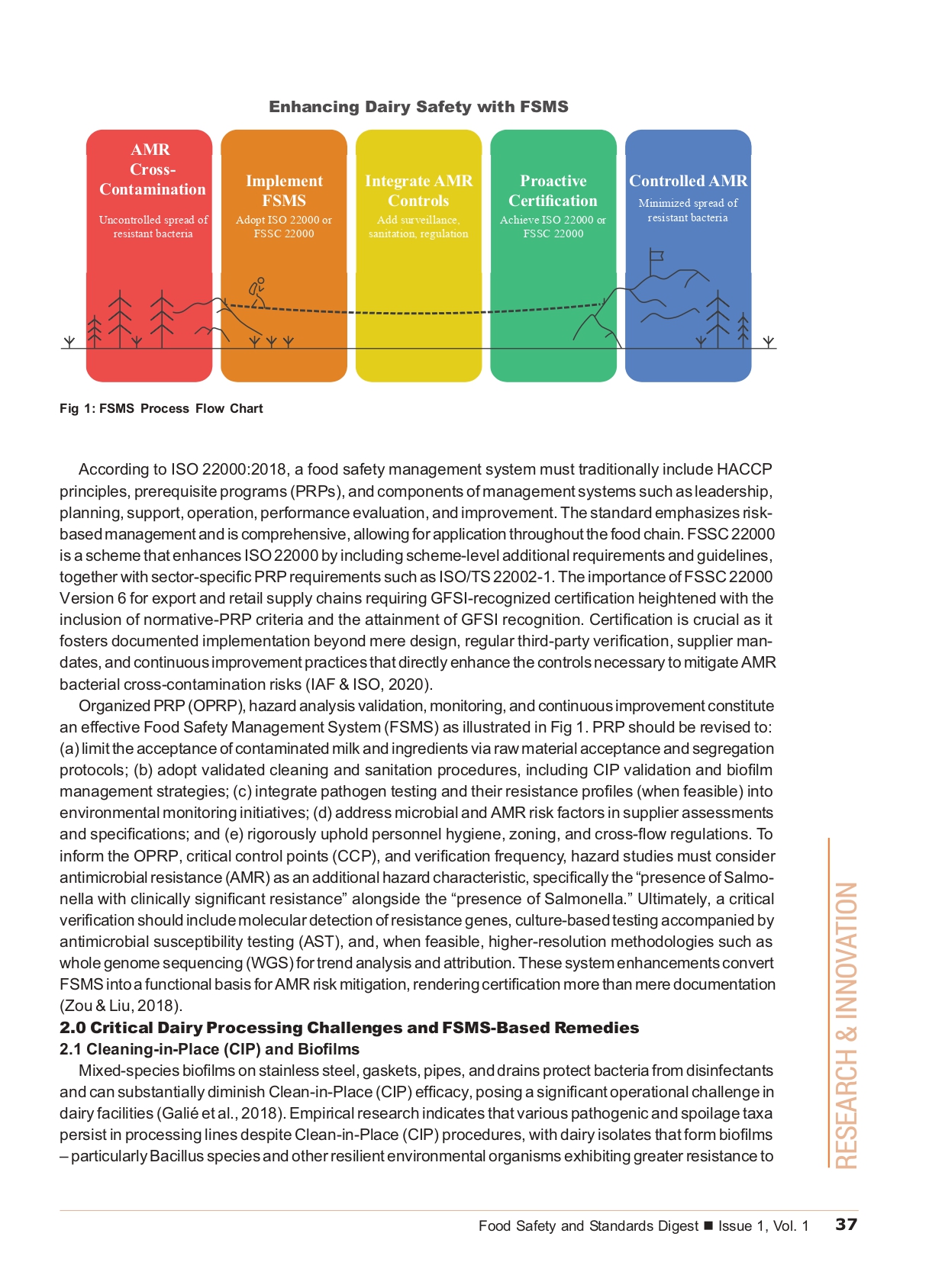
Organized PRP (OPRP), hazard analysis validation, monitoring, and continuous improvement constitute an effective Food Safety Management System (FSMS) as illustrated in Fig 1. PRP should be revised to: (a) limit the acceptance of contaminated milk and ingredients via raw material acceptance and segregation protocols; (b) adopt validated cleaning and sanitation procedures, including CIP validation and biofilm management strategies; (c) integrate pathogen testing and their resistance profiles (when feasible) into environmental monitoring initiatives; (d) address microbial and AMR risk factors in supplier assessments and specifications; and (e) rigorously uphold personnel hygiene, zoning, and cross-flow regulations. To inform the OPRP, critical control points (CCP), and verification frequency, hazard studies must consider antimicrobial resistance (AMR) as an additional hazard characteristic, specifically the "presence of Salmonella with clinically significant resistance" alongside the "presence of Salmonella." Ultimately, a critical verification should include molecular detection of resistance genes, culture-based testing accompanied by antimicrobial susceptibility testing (AST), and, when feasible, higher-resolution methodologies such as whole genome sequencing (WGS) for trend analysis and attribution. These system enhancements convert FSMS into a functional basis for AMR risk mitigation, rendering certification more than mere documentation (Zou & Liu, 2018).

FSMS Process Flow Chart

Fig 1: FSMS Process Flow Chart – Enhancing Dairy Safety with FSMS

AMR Cross-Contamination

Uncontrolled spread of resistant bacteria

Implement FSMS

Adopt ISO 22000 or FSSC 22000

Integrate AMR Controls

Add surveillance, sanitation, regulation

Proactive Certification

Achieve ISO 22000 or FSSC 22000

Controlled AMR

Minimized spread of resistant bacteria

2.0 Critical Dairy Processing Challenges and FSMS-Based Remedies

2.1 Cleaning-in-Place (CIP) and Biofilms

Mixed-species biofilms on stainless steel, gaskets, pipes, and drains protect bacteria from disinfectants and can substantially diminish Clean-in-Place (CIP) efficacy, posing a significant operational challenge in dairy facilities (Galié et al., 2018). Empirical research indicates that various pathogenic and spoilage taxa persist in processing lines despite Clean-in-Place (CIP) procedures, with dairy isolates that form biofilms – particularly Bacillus species and other resilient environmental organisms – exhibiting greater resistance to CIP and disinfectants compared to non-dairy strains (Grau-Sánchez et al., 2018; Khadka et al., 2019). This persistence not only promotes continuous product contamination but also creates microenvironments conducive to horizontal gene transfer, potentially spreading resistance genes across many taxa. PRPs must necessitate validated CIP parameters and incorporate enzymatic cleaning alternatives, challenge-based validation (biofilm removal efficacy), and combined chemical-physical approaches (Curioni et al., 2021). Ban-Cucerzan et al. (2025) assert that certification requires environmental monitoring and documented validation, facilitating the discovery and elimination of persistent biofilms.

2.2 Sanitary Zoning, Product Flow, and Facility Architecture

The risk of cross-contamination is heightened by obsolete or poorly designed facilities, including shared lines, mixed raw and finished product flows, and complex plumbing that hinders effective Clean-in-Place (CIP) procedures. Hygienic design, hygienic maintenance, and preventive maintenance protocols that reduce contaminant niches are essential for ISO/FSSC PRPs. These engineering controls are mandatory rather than discretionary, as the guidelines and annexes establish realistic standards for sanitary design and environmental monitoring (FSSC Foundation, 2023).

2.3 Workflow and Human Factors

Incidents of contamination are frequently attributed to personnel movement, training, and conduct. The efficacy of human controls is enhanced by FSMS components pertaining to internal audits, delineation of roles, documentation of training, and management commitment. Corrective action techniques facilitate the closure of feedback loops, whereas certification audits expose procedural and cultural deficiencies. This involves instructing personnel on the hazards of AMR, sample management, cross-contamination prevention, and sanitizer stewardship — subjects that certification programs formalize (Zimon et al., 2020).

2.4 Supply Chain

Agricultural operations may contribute significantly to the AMR load. The supplier controls of FSSC 22000 are generally more prescriptive and enforced, while accredited systems necessitate supplier approval and stipulations. The probability of introducing high-risk items into the facility is diminished by implementing supplier audit systems, establishing traceability for antibiotic usage, and adhering to supplier microbiological and antimicrobial resistance requirements (Pires et al., 2024; FAO, 2025).

2.5 Empirical Deficiencies

Multiple scoping reviews delineate antimicrobial resistance (AMR) patterns in dairy farms across Asia and globally, highlighting surveys of E. coli, S. aureus, and other pathogens exhibiting significant resistance to tetracyclines, β-lactams, and aminoglycosides. An extensive body of literature elucidates AMR in dairy farm settings, including feces, slurry, wastewater, and the farm environment, alongside increasing evidence of AMR genes in dairy-associated ecosystems (Veloo et al., 2025). A substantial body of research on biofilms, CIP resistance, and advanced cleaning techniques in dairy processing — such as enzymatic formulations and combined chemical approaches — demonstrates that validated cleaning and combination treatments can significantly reduce biofilm biomass and viable counts in both pilot and industrial settings. This research (Patil et al., 2021) supports the mechanistic plausibility that improved sanitation and validated PRPs can reduce AMR reservoirs in plants.

Nevertheless, there is limited empirical research that directly compares accredited and non-accredited dairy facilities for AMR outcomes, or that investigates the occurrence of AMR in these facilities prior to and subsequent to ISO 22000 or FSSC 22000 certification. The literature on the efficacy of ISO 22000 indicates that enhanced HACCP implementation, adherence to process control, and superior hygiene metrics are typically observed in certified organizations (Banovic & Markovic, 2016). Nonetheless, these studies typically present conventional food safety indicators or compliance results instead of the incidence of antimicrobial resistance (AMR) itself (Jairath & Purohit, 2013). Consequently, a significant data deficiency exists: while certification improves systems that purportedly reduce AMR cross-contamination, multi-site, longitudinal studies measuring AMR endpoints are necessary to assess the magnitude of the impact. When formulating direct causal claims, this gap must be acknowledged (Sasikumar Nair et al., 2023).

3.0 Roadmap for Prioritization and Implementation

Dairy facilities must have a strategic plan to implement certification as a method to mitigate antimicrobial resistance (AMR). Initially, allocate cross-functional responsibilities (production, procurement, sanitation, and quality assurance) and secure commitment from senior management for resource allocation. Identify AMR-specific deficiencies, like insufficient AMR surveillance, absence of biofilm challenge tests, or inadequate supplier criteria, by performing a gap analysis in accordance with ISO 22000:2018 and the relevant PRP standard (e.g., ISO/TS 22002-1) or the FSSC 22000 V6 Scheme (Zou & Liu, 2018). Furthermore, employ risk rating to evaluate controls (drains, raw milk reception, pasteurizer seals, and CIP validation) and broaden the HACCP hazard analysis to explicitly incorporate AMR as a factor. Synchronize verification schedules to focus on higher-risk nodes and accurately delineate OPRPs and CCPs. Furthermore, enhance PRPs by instituting a risk-based environmental monitoring program that encompasses focused AMR testing (culture + AST and PCR for priority genes), regulating sanitizers (rotation, concentrations, and contact duration) to avert selection pressure, employing enzymatic or combined cleaning as required, and validating CIP protocols (including biofilm challenge assessments). Incorporate microbiological and antimicrobial resistance (AMR) stipulations into procurement contracts and arrange supplier evaluations (Guerrero-Navarro et al., 2022). Establishing data and verification protocols is also advantageous. This encompasses management evaluations associated with AMR trends, root cause analysis for AMR detection, CAPA documentation, and regular environmental and product testing for infections and resistance profiles. Utilize external accredited laboratories for AST and sequencing to guarantee source attribution whenever feasible (WHO, 2016). Fifth, integrate behavior-based observations and leadership metrics into routine audits; educate personnel on antimicrobial resistance concerns, biofilm management, sanitizer use, and sampling protocols. Finally, document all aspects: supplier assessments, sanitation verifications, monitoring results, and audit documentation. Certification audits will examine records and the effectiveness of corrective efforts (Zimon et al., 2020).

3.1 Metrics for Monitoring Effectiveness

Implementing SMART (Specific, Measurable, Achievable, Relevant, Time-bound) indicators across process, environmental, product, and trend-analysis domains is essential for evaluating the effectiveness of modifications to the Food Safety Management System (FSMS) in mitigating antimicrobial resistance (AMR) cross-contamination. Examples of process-level metrics include the proportion of precondition programs (PRPs) and operational PRPs (OPRPs) that are verified and maintained in a controlled state, clean-in-place (CIP) validation log-reduction values, and the monthly count of sanitation non-conformities. The proportion of environmental samples that yield positive results for target organisms and the proportion of isolates exhibiting specified resistance characteristics serve as examples of environmental indicators. Metrics related to the product may track both the proportion of completed lots displaying pathogen detection and the proportion of lots having resistant isolates. Finally, molecular typing or whole-genome sequencing (WGS) can facilitate source identification and long-term surveillance, whilst time-series control charts can differentiate between persistent strains and sporadic contamination events.

3.2 Limitations, Costs, and Equality Concerns

Advanced AMR surveillance and certification necessitate substantial resources. The costs associated with further environmental sampling, AST, periodic sequencing, and CIP improvements may be excessive for small and medium-sized enterprises (SMEs). Regulators and industry groups should consider subsidies, collaborative laboratory networks, or incremental compliance strategies due to the potential variability in implementation based on regional differences and enterprise size. Scientific limitations encompass intricate attribution (agricultural versus botanical origin) and detection sensitivity; occasionally, low-prevalence resistant subpopulations may be overlooked without selective enrichment. Consequently, policy formulation must emphasize capacity enhancement and achieve a balance between feasible surveillance methods and achievable PRP advancements (Veloo et al., 2025).

3.3 Research Agenda

It is being necessitated that longitudinal and comparative investigations that assess AMR endpoints pre- and post-certification, or that juxtapose accredited and non-accredited facilities matched by size and processing profile, to progress from mechanistic plausibility to quantifiable impact. Molecular detection of resistance determinants (qPCR), antimicrobial susceptibility testing panels for priority drugs, environmental and product monitoring, and whole genome sequencing for strain tracking and source attribution are all essential components of study. Conducting interventional studies of established biofilm removal strategies, employing enzymatic cleaning-in-place and mixed chemical cycles with antimicrobial resistance outcomes, might also be advantageous. One-Health research must be prioritized by funding organizations and industry consortiums to guide certification standards and evidence-based policy.

3.4 Recommendations for Industry and Policy

Regulators and industry associations ought to assist SMEs through subsidies or access to communal laboratory services while endorsing ISO 22000 and FSSC 22000 as foundational food safety management systems. Scheme owners and auditors should consider incorporating optional AMR modules or recommendations for environmental surveillance and biofilm validation. Public health groups should advocate for laboratory networks to enable routine antimicrobial susceptibility testing and molecular diagnostics for industrial verification. Ultimately, attribution and intervention targeting would be markedly improved by a collaborative One-Health data-sharing system encompassing agriculture, horticulture, and public health (FSSC Foundation, 2023).

4.0 Conclusion

Dairy plants can manage food safety threats through structured certification under ISO 22000 and FSSC 22000. Certification can markedly reduce the probability of cross-contamination of antimicrobial-resistant organisms when Food Safety Management Systems are explicitly adapted to include antimicrobial resistance risk factors such as validated biofilm management, antimicrobial resistance-focused environmental monitoring, supplier antimicrobial resistance requirements, and sanitizer stewardship. However, there is scant empirical evidence directly linking certification to reduced AMR prevalence in industrial environments; comprehensive comparative and longitudinal studies are necessary. Simultaneously, the most effective method to mitigate the risk of AMR cross-contamination in dairy value chains is to integrate certification with targeted operational modifications, capacity enhancement, and One-Health surveillance.

References

Ban-Cucerzan, A., Imre, K., Morar, A., Marcu, A., Hotea, I., Popa, S. A., et al. (2025). Persistent threats: A comprehensive review of biofilm formation, control, and economic implications in food processing environments. Microorganisms, 13(8). https://doi.org/10.3390/microorganisms1308xxxx

Banovic, M., & Markovic, Z. (2016). HACCP effectiveness between ISO 22000 certified and non-certified dairy companies. Food Control, 53, 134–139. https://doi.org/10.1016/j.foodcont.2015.01.030

Curioni, A., Ripolles-Avila, C., Rios-Castillo, M., Fontecha-Umaña, A., & Rodríguez-Jerez, J. J. (2021). Effectiveness of enzymatic treatment for reducing dairy fouling at pilot-plant scale under real cleaning conditions. Food Control. https://doi.org/10.1016/j.foodcont.2021.xxxxxx

Food and Agriculture Organization of the United Nations. (2025). Codex texts provide a pathway for global action on foodborne antimicrobial resistance. FAO.

Foundation FSSC. (2023). FSSC 22000 scheme version 6. Foundation FSSC.

Galié, S., García-Gutiérrez, C., Miguélez, E. M., Villar, C. J., & Lombó, F. (2018). Biofilms in the food industry: Health aspects and control methods. Frontiers in Microbiology, 9, 898. https://doi.org/10.3389/fmicb.2018.00898

Grau-Sánchez, B., et al. (2019). A systematic characterization of biofilm distribution and CIP resistance in a milk powder processing factory. International Journal of Food Microbiology, 300, 15–26. https://doi.org/10.1016/j.ijfoodmicro.2019.04.014

Guerrero-Navarro, L., Torres, P. L., & González, G. L. (2022). Effectiveness of enzymatic treatment for reducing dairy fouling at pilot-plant scale under real cleaning conditions. LWT – Food Science and Technology, 154, 112599. https://doi.org/10.1016/j.lwt.2021.112599

International Accreditation Forum, & International Organization for Standardization. (2020). Expected outcomes for certification to ISO 22000: Food safety management systems. IAF/ISO.

Jairath, M. S., & Purohit, P. (2013). Food safety regulatory compliance in India: A challenge to enhance agri-businesses. Indian Journal of Agricultural Economics, 68(3), 431–448.

Khadka, B., et al. (2019). Robust biofilm-forming Bacillus isolates from dairy environments demonstrate enhanced resistance to CIP procedures. Frontiers in Microbiology. https://doi.org/10.3389/fmicb.2019.xxxxxx

Patil, A., Banerji, R., Kanojiya, P., & Saroj, S. D. (2021). Foodborne ESKAPE biofilms and antimicrobial resistance: Lessons learned from clinical isolates. Pathogens and Global Health, 115(6), 339–356. https://doi.org/10.1080/20477724.2021.1916158

Pires, A. J., et al. (2024). Antimicrobial resistance in dairy cattle and the dairy supply chain: A review. Antibiotics. https://doi.org/10.3390/antibioticsxxxxxxx

Sasikumar Nair, S., Mazurek-Kusiak, A. K., Trafiałek, J., & Kolanowski, W. (2023). Assessing food safety compliance in a small-scale Indian food manufacturer before and after certification of food safety management systems. Applied Sciences, 13(22), 12190. https://doi.org/10.3390/app132212190

Veloo, Y., Thahir, S. S. A., Mansor, R., Zakaria, Z., Rahman, S., & Rajendiran, S. (2025). A scoping review unveiling antimicrobial resistance patterns in the environment of dairy farms across Asia. Antibiotics, 14(5), 436. https://doi.org/10.3390/antibiotics14050436

World Health Organization. (2016). Antimicrobial resistance: A manual for developing national action plans (Version 1). WHO.

Zimon, D., Madzik, P., & Domingues, P. (2020). Development of key processes along the supply chain by implementing the ISO 22000 standard. Sustainability, 12(15), 6176. https://doi.org/10.3390/su12156176

Zou, M., & Liu, D. (2018). Distribution, biofilm-forming potential and resistance of bacteria to CIP processes in a milk powder processing factory. Food Research International, 113, 316–326. https://doi.org/10.1016/j.foodres.2018.07.027

Author Biography

Monica Puniya

Food Safety and Standards Authority of India, New Delhi 110002, India

Correspondence Email: monica.puniya@fssai.gov.in